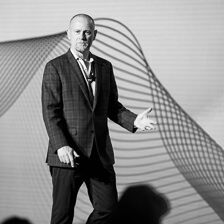
At the very start of the debate about whether the traditional real estate office would survive the next five years, Elite Agent‘s fabulous Samantha McLean made sure Peter Brewer and I were in the right headspace. She said, “This is exploration, not combat. We’re stress testing ideas together.”

That was probably a good thing, not because we would have truly butted heads, but because what we actually ended up stress-testing was the definition of “traditional” real estate office. Of course, the framing was deliberately provocative: “The traditional real estate office will be extinct in five years.”
A False Binary
As I said in my introductory post to this conversation, or as Peter called it, “my concession speech,” debates almost necessarily force false binaries. And what certainly wasn’t lost on Peter was that artificial intelligence had created the definition.
The Problem With The Definition Of A Traditional Real Estate Office
Most of the tension in this debate didn’t come from a deep disagreement about the future of real estate. It came from the definition we were asked to work with.
The “traditional real estate office” was defined as a high-street storefront. Listings in the window. Desks for agents. A reception area. A physical anchor for local transactions. Once that definition is on the table, the conversation is forcefully narrowed. We were never asked to debate the profession of real estate. We were asked to examine a specific kind of space, designed for a very particular moment in time.
And to be fair, that definition is woefully incomplete. Peter was right to challenge it as his opening salvo. Anyone who has spent time inside real estate businesses knows there is no single model. There are thousands of offices that look, feel, and function very differently. A few already operate as community hubs. Others are highly specialized, relationship-driven environments that really don’t resemble the stereotype at all.
But that simplified definition didn’t come out of nowhere.
From a consumer’s perspective, it still reflects what many people encounter when they move through their cities and suburbs. Listings in the window. Lights on. Very little visible activity. I have one of them near me in Santa Clarita. And I experienced several in the few block radius of our Airbnb in Buenos Aires.
Whether that represents the best of the industry is beside the point. AI didn’t invent that definition out of thin air. It surfaced a pattern.
Large language models are trained on what’s most commonly written, photographed, indexed, and reinforced. When asked to define a “traditional real estate office,” it returned the version that has been most consistently visible for decades.
The Artificial Intelligence Definition Was A Mirror
In a strange way, AI was simply holding up a mirror. Not to how real estate professionals understand their work from the inside, but to how the industry has been collectively presented to the outside world. That specific definition reflects what has been easiest to describe, easiest to photograph, and easiest to reduce to a pattern.
Of course, it’s a caricature. But that should give everyone in the industry pause.
Because if AI will now be mediating how consumers learn, compare, and decide, then the models it returns are important. If the dominant mental model of a real estate office is still a mostly empty storefront optimized for transactions, that’s not just a branding problem. It’s a trust problem.
That’s why I chose to accept the definition rather than rewrite it. Not because it captures the full reality of the industry, but because it helps to surface an important gap between how real estate professionals experience their work and how real estate spaces are often experienced by the public.
So yes, the definition Peter railed against is telling. Not because AI got it “wrong,” but because it showed us what has been most reinforced over time.
And frankly, if we don’t like the definition it surfaced, the responsibility doesn’t sit with the technology. It sits with us. It’s up to us to change what becomes visible, memorable, and worth modeling going forward.
The Real Estate Experience Question
I’ve encountered this one so many times in my 25 years in real estate technology. It’s the “how can you even be in this discussion if you’ve never sold a home” argument. A younger me might have bristled. I find it informative at this point.
Early in the debate, Peter asked me a series of questions about my “real estate experience. I responded “zero” to all of them. “How many homes have you sold? How many listing presentations have you done? How many deals have you saved at the last minute in person, where there’s been a shity building inspection come in, and you’ve used your humanity as a real estate professional to keep that transaction together?”
I’m no stranger to the real estate industry, to what REALTORS® do, or to their value. Peter knows that. But I understood what he was trying to say, and it only reinforced a different point. I think the question discounts the consumer’s experience on the other side of the transaction, frankly. I know he was doing it specifically for the debate, but I am quite sure these questions miss the point.
A traditional real estate office hasn’t done any of those things either. It was a human with a trusted relationship with another human. Always. And that is one thing I also have a great deal of experience with: the value of a trusted human in important decisions.
Once we got that out of the way, the debate softened considerably. We weren’t really arguing about whether offices should exist. We were exploring which kinds of spaces still make sense and which might need a bit of reconsideration.
In that sense, the disagreement was less about extinction and more about intention. What do we mean when we say “office,” and what do we actually want that space to do for the people it serves?
Where Peter And I Agreed
This is actually the easiest part to write about, because we agreed on way more than we disagreed. I love Peter like a brother, so this was never going to be anything but a great conversation. I think a great conversation is one where people from different experiences find common ground. In that sense, this was a great conversation.
Bad Space Is The Real Enemy
We both agreed that this wasn’t really about “bad offices.” Offices designed around transactions and information are outdated. They are not fit for purpose. Empy underutilized spaces are simply a liability. And I would argue that if those spaces serve to perpetuate the caricature of a real estate agent, then it’s up to us to redraw that picture. Haven’t the caricatures gotten old?
AI Changes the Value of Physical Space, Not the Need for It
I believe that the spaces that survive, regardless of the time window, will justify their existence even when no deal is in the works. They’ll earn foot traffic without demanding it. They’ll feel less like workplaces and more like the third spaces Brad Nix talks about; places where life already happens, and business emerges naturally, not transactionally.
As I said, AI is going to own the web, our mediated spaces. Humans need to own the room. The future of real estate does not belong to offices designed around transactions. It belongs to spaces designed around trust. It belongs to spaces designed around relationships, around humans.
What does that look like? I don’t have a clear answer for that, but, for my money, it most certainly doesn’t look like the definition of the traditional real estate office AI has echoed back to us.
Place matters more than ever.
The Office as Community Anchor, Not Workplace
Peter mentioned in our debate that offices that function as hubs already exist. He said, “I’m going to go straight out of Australia here across to John Ross at the Professionals in Hutt City in Wellington. 65 salespeople, a leased out a coffee shop downstairs. There’s a kindergarten operating inside the business.”
From the Professionals Redcoats Limited website, “At our Lower Hutt office, Café Twenty Eight conveniently sits adjacent to our reception area. This provides an ideal setting to enjoy a cup of coffee or savor a delicious bite while engaging in discussions about real estate with us.”
This feels like exactly what I was arguing for.
Replacing The Definition Of The Traditional Real Estate Office
If Peter and I had any real disagreement, it was probably over tempo and timing. Peter expressed justified skepticism, shaped by decades of “next big thing” cycles on conference stages. He’s not wrong to feel that way.
AI just hits different to me. I feel a real sense of urgency around AI’s trust-forming capabilities. And that’s why I think we both agree that the action we can likely agree on has to necessarily reshape what people think of when they think of a “traditional real estate office.”
If the AI’s definition is indeed a mirror, we need to take a hard look at what it shows us. And so after our debate, I’m more convinced than ever that what replaces the previous definition of traditional real estate offices will be more human, not less. More relational, not more technical. More lived-in, not more polished.
The future of real estate isn’t fewer spaces.
It’s spaces that redefine perceptions.
It’s better spaces.
The video of the debate on whether the traditional real estate office will be extinct in five years will not be released for a couple of weeks due to preexisting production schedules. When released, it will appear on “Edge Case” at Elite Agent.
Add your voice...